Concerning Flannel, Land Lines, and Paper Routes

Do you remember life before the internet?

“First of all, how dare you?!” I demand as I throw away the AARP form that came in the mail.
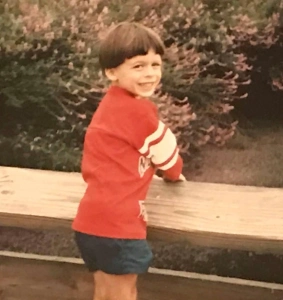
My daughter didn’t believe me when I told her I had the same haircut as the kid from Stranger Things.

Was there such a time? Of course there was. Obviously the concept of the internet had been around about as long as I have (1982), but in practical terms it wasn’t useful to me until about 1998 when my family got our first PC; a Gateway 2000 complete with a 56K modem. We had dial up internet that had a number we called from the computer and if it was between 5 and 6 PM you could forget about actually getting connected. Then the computer would scream at you in this high-pitched tone until you got online.

There are varying levels of internet that we might take into consideration. My kids don’t really understand that it wasn’t always portable. Back in the old days when I was a newly minted EMT (back when the men were men and the sheep were scared) we had to use a map book to figure out where we were going. GPS wasn’t user friendly and I remember my step-father’s Magellan crapping out on us in the middle of the woods while we were hunting.

For a long time anything social media based had to be accessed from your desktop or laptop (maybe you had this new thing called WiFi?). If you wanted to know what your friend had for dinner you had to call and ask them. This paragraph would seem strange because posting a picture of your meal is only a recent example of how stupid our society has become.

But life before the internet? The first thing that comes to mind from that Halcyon era was how we stole music. First, you had to have a radio, CD player, or turn table with a cassette tape deck. If you had the song you wanted to steal on CD or LP (even another tape) it was easy: play the song on the platform you had and record it onto the tape. If you didn’t things got a little more complicated…

The radio could play a song, but that meant you had to have some idea of when they’d play it. DJ’s weren’t in the business of letting you know they were about to play a song directly but there could be clues. The easiest was if your song was in the Top 10 and you knew where it was, this was just a matter of waiting. If it wasn’t, you were in for a wait.

It would never fail that you’d be away from the stereo long enough for them to start playing it, and you’d have to dive across your bedroom to hit the PLAY/RECORD button. You could also bet on one song melding into another, or the DJ talking over most of the intro or ending, but since you’re stealing the song you can’t really complain. You could call the radio station and request a song, but you never knew when they’d get around to playing it.

Mix tapes were a thing. No playlists on your phone, that’s too easy and you lose all sense of the art that’s involved in stealing a band’s intellectual property. I’ve explained making of a mix tape to my Zoomer partners, and they’ve seemed interested enough, or maybe they were just being polite. It could take hours if you had the music on hand or weeks to wait for tracks on the radio. Burning CDs wasn’t really a thing until the latter half of my high school years and by then we had Napster and that bright shining moment…

Genuine 90s flannel

There was no On Demand, and certainly no streaming of anything. If you wanted to watch a show after it aired you had to make sure you taped it on VHS. This meant searching for a blank tape, or sacrificing the video from your sister’s ballet recital to get that bootlegged copy of Temple of Doom.

Calling someone’s house was another thing. Before mass use of cell phones we had to call our friends on the landline. If your buddy’s mom answered the phone you’d have to make small talk with them “Mom is good, I’ll let her know you asked for her. Could I talk to Bobby please?” If you got up the nerve to call that girl you liked there was a 100% chance her dad or her older brother would pick up the phone and you’d have to talk to them first.

I remember driving to The Cape with my dad in his old Wrangler. No doors, no roof, which isn’t such a big deal considering Jeeps are still a thing. Keep in mind one thing: to paraphrase an Australian cartoon dog “It was the 80s, man!” I was seated up front at an age that I had my own kids safely in booster seats in back. We also ate cherries off a styrofoam tray straight from the grocery store and Big Macs came in a similar container. Not the most environmentally friendly time.

I feel like we spent more time I outside than today’s kids do. We knew where everyone was because they’re was a pile of bikes dumped in someone’s front yard and we just gravitated toward it like moths to a flame. The signal to come home was the street lights and I remember jumping sketchy ramps on my bike built by my friends and cousins.

Summer camp was a big deal, and I’m watching the local school boards shifting toward year-round school with some concern. Granted, they allow for time off in the year, but that might make it harder for summer camps to operate if there is an unreliable flow of kids to fill cabins. Education is important, don’t get me wrong, but I feel like there’s something about taking a dump in the woods that connects us to our origins.

Gaming wasn’t like it is now. We had computers or consoles, but you weren’t going to play with your friend across town, and forget anyone on the other side of the planet. You could do multiplayer with two, maybe four, players if you had the right set up. If your cartridge didn’t play right the first time you had to blow into it like you were giving it CPR and if it didn’t work after that you did it until you felt dizzy or it worked.

I had to learn the Dewey Decimal System, which was how we looked up books in the library. There was no Google, and my dad ordered a complete set of encyclopedias so we could look something up if we needed to. If it wasn’t in there, a trip to the library was in order.

We got our news from TV, radio, or the newspaper. If I was your paperboy I’d fly past your house on my BMX with an arsenal of wrapped up newspapers, the finest muck Fall River, Massachusetts could rake. I’d then chuck it at your front door at the hour of 6AM keeping a kind of mental score based on where it landed. Maybe you’d tip me, maybe not, but I can guarantee that if your tipped well I’d pick a good one for you out of the bundle, fold it nicely and place it out of the rain so you could read your paper without lawn clippings or dog crap on it.

We were happier for sure, as a quick Google search confirms. This might be because there wasn’t really a 24 hour news cycle and no constant habit of doom scrolling. The news came on certain network channels a few times per day and if it made us unhappy or concerned we could turn it off and walk away. Mind you, I was lucky. I was alert and oriented through the 90s (2000s were a slightly different story) and it was bookended by the Soviet Union and terrorism. There wasn’t much to worry about, at least from a young kid to teenage perspective.

MTV really did play music videos, and was in competition with VH1. Music videos as faaaaaar as the eye could see, sometimes with commentary from Beavis and Butthead. Going back a little farther I can confirm that hair bands, those gloriously effeminate, yet somehow manly, rockers were once gracing the screens of America when the most effective weapon the West could muster against the Godless Soviet hoards was Rock & Roll. *drags on an unfiltered Camel from the driver’s seat of an IROC*

We wrote letters, which is probably my favorite niche thing to reflect on. Getting a text or an email is really impersonal, but a letter, hand written by someone specifically to you was a special thing to find in the mail. It meant someone had taken time out of their day to put pen to paper their thoughts and feelings just for you. I had a pen pal in Australia that I kept up with for a number of years, as well as a girl I met at summer camp.

There’s another reason not to change to year-round school. The friendships I made over long, hot New England summers can’t be replicated in short breaks throughout the year. These were kids who lived out of state from me in ever would have met if we weren’t both out of school at the same time. You’d think with all the tech advancements in learning now it would free up more time to actually be a kid, but that’s not the point of education is it?


My novel Just Say Maybe has an awesome example of how to make a mix tape and is a great example of how we survived in the time before the internet.

Continue reading

CALVINISTS IN SPAAAAACE!

Hey, wasn’t this guy a novelist?

The big project of the last 18 months has been something that I’ve been mulling over for about twenty years or more. Back in high school, I had a friend who had sketched out a science fiction universe in the tone of a space opera and I more or less attached myself to his project like a Xenomorph, crafting my own storylines and characters as spin-offs that lived happily inside the universe that he created. Our lives took us in different directions, but a few years later while taking a creative writing class in college I wrote a short story based in that universe and he was so happy when I sent a copy of it to him that he gave me the best compliment he could after I’d face-huggered his project. “It’s as much yours as it is mine now.”

And from there it went into stasis, like Khan and his crew floating aimlessly through space only to be discovered, thawed out, and take over my writing life in my late 30s. Most of the concept was scrapped as unusable and obvious rip-offs of a number of different sci-fi franchises, but then again most are. Like Twain noted there are no original ideas, but we can renew, rework, and rebuild ideas like a cyborg.

The problem I had with sitting down to write a space opera wasn’t the plot line. I already knew what that was going to look like. It’s your basic interstellar travel synopsis paired with a good versus evil theme, but I wanted to do something that touched on societal constructs that went beyond federations or councils, beyond overpowering corporate entities that cast entire planetary systems into darkness out of their own greed. There’s plenty of that already, and if I’m honest, as much as I like Star Trek the concept of a society that has done away with all the worst human traits like greed or racism is totally unbelievable. Transporters are a more realistic notion than humans shedding their worst traits in favor of a willful embrace of egalitarianism.

The reason is man’s total depravity, a Christian concept rooted not simply in the Doctrines of Grace but is latent throughout scripture. It is humanity’s condition and illustrates that people are inclined to do bad, and while they won’t necessarily do those things, it’s not something we can just do away with. We would rather indulge our own base desires than go against them.

The problem with my project is how to execute it. If I was going to attempt a space opera with a Christian undertone I knew immediately that it would put a number of people, many of them actual Christians, off. When people consider Christian entertainment they cringe because, frankly, most Christian entertainment is pretty terrible. There are a couple of limited exceptions, but most are infected with heresy or Second Commandment violations, specifically depictions of God, Christ, or the Holy Spirit.

Most Christian entertainment is nauseating in its presentation. In most cases, it’s written with Baby Boomers in mind with a premise as predictable as a Hallmark Channel Christmas movie. There’s a weak plot, some pet sin the protagonist can’t get around until he or she makes a conscious decision to accept Christ into their heart. There’s probably a full immersion baptism, atheist arguments made by characters who are as one-dimensional as the Christian protagonist who slays them, and probably a lovable dog or kid thrown in to add to the pot-luck feast of imagery we think makes up the actual world ruled by the devil.

The problem, as I’ve seen it, is that as Christians we put ourselves into these bubbles where we insulate ourselves from the influences of this world (rightly so) but then we try to appeal to people who are not just influenced by it but enslaved by it, and then wonder why they laugh at our feeble attempts to evangelize within the bounds of material that we deem safe. Aside from this, you have people who are new converts working through their sanctification, part of which is eliminating entertainment that will cause them to fall into sin, and they’re getting sanitized versions of a world that doesn’t exist. They know doesn’t exist because they’re so closely removed from it. We have to do better and we can.

This is what makes this project harder. I can’t just deus ex machina things into resolution. That doesn’t mean God doesn’t intervene, but there’s not going to be a physical hand of God moment that resolves all the issues. No “God’s hand coming down to touch a nuclear bomb and destroy all the bad guys” moment (which was a really disappointing climax to one of my favorite Stephen King stories, I don’t mind adding. The rest of it was a total masterpiece, but that part I hated). God the Father, Son, or Holy Spirit can’t actually make an appearance either, but I can play with other aspects of the created realm.

This is ultimately a story about revival and it is suggestive of Old Testament prophecy as it points to Christ. It’s Reformed in that the theology it contains touches all the Doctrines of Grace, known under the acronym TULIP. The hyper-abridged version is what I’ll offer:

Total Depravity – Man’s nature is inherently evil, but you’re not as bad as you could be. We’d just rather do bad things than do what’s right.

Unconditional Election – You don’t choose God (and you wouldn’t anyway because you’re totally depraved). God chooses you.

Limited Atonement – Christ died for the elect (see Unconditional Election), not everybody.

Irresistible Grace – That you’re called by God and it’s not something you can just walk away from. It’s compelling and you actually want to go to Him.

Perseverance of the Saints – The “Once saved, always saved” principle.

Set in the same universe as The Delirium: A Zombie Opera of the Great War there is folklore about the dead rising in an apocalyptic event that set the course for much of human history. Religion has been done away with and is largely illegal, practiced in secret much like in communist utopias like the former Soviet Union and modern China. The difference here is within this fictional universe they won’t throw you in prison for being a Christian, Jew, or Muslim, but they’ll find ways to make your life difficult, leading up to a possible prison sentence if you really wear it on your sleeve. Here your religion is the state and you will bow to the proverbial chocolate bunny.

The thing is the skies are still sunny, despite the smog, and people go along happily with their lives. There’s no real domineering element that’s keeping people down. Certainly, there is a suggestive caste system, but the two primary groups of humans are too busy trying to subvert one another to oppress their own people. Their people are largely happy, so ultimately faith is seen as something that’s unecessary, at least on the surface, just like many who live happy lives on social media, but are miserable in their hearts. 

“Why do we need God when we have gods of gold, food, and sex?” they might ask. Ambition is their driving factor, not holiness. To this end, some characters are put into a position where they need to turn to something when faced with the vacuum of space and certain death all around them. Note that I wrote “some” not all. That’s your Limited Atonement and Irresistible Grace.

This doesn’t amount to high fantasy, much of this is as theologically sensitive as I can make it. It’s a space opera with a revival theme. There are those who turn from sin and those who don’t. Some who turn from their sins die horrifying deaths while others who embrace it live long and fruitful lives. Jacob I have loved… (Romans 9:13)

There are some cool things I put into this. I stole, and modified, transporters from Star Trek, personal shields from Dune, and people who have special powers I took from Star Wars, Stranger Things, and basically everything else you could think of. There are no aliens, per se, but there is a small horse-like animal with a horn they name a unicorn.

Much of the writing from here out will be piecemeal as I’m in school again (a subject for a different blog entry). But a major portion of this was written over two NaNoWriMo sessions and at least one Camp NaNoWriMo. From here it’s gentle plodding, but I could have it done in a couple of years. I’ll work some way into illustrating some of the material without giving too much of the plot away.


James Windale is the author of the Twenty-Five at the Lip series, Tuesday’s Gone, Just Say Maybe, and The Delirium: A Zombie Opera of the Great War.

Critical

It’s early, and with the drive to his house I’ve had a much earlier start than Barry. I roll up to his house and he waves to me, an unlit cigar clenched in his teeth as he’s passing a pair of rods through the back gate of his 4Runner. It’s about as old as he is, at least in car years, and ambles along with a similar limp.

I spent the first year of my career running with my local hometown volunteer ambulance corps, and the satellite operation of a private outfit based out of Boston. I learned nothing my first year, relegated to a “Get out of the way” attitude and dialysis transports. Not so with Barry. After moving to Pinellas County, Florida at the end of 2004 I took a job in a local emergency department. Barry was assigned to me as a preceptor. A cardiac arrest rolled in that first night and when I told him I’d never done CPR before he threw me to the wolves. I learned more in a month than I had in the past year. “Crackin’ ribs your first night on the job! Kid’s a fahkin’ natural.”

Barry had been a corpsman with the First Marine Division in Vietnam. The hitch in his gitty-up was a combination of shrapnel and too many years playing semi-pro soccer in Europe (that’s futbol to us American savages). He became a Registered Nurse after realizing his playing days were over and had been wheeling and dealing in local ERs and ICUs ever since.

“It’s critical,” he’d emphatically state over some essential medical intervention, chewing a wad of gum when he couldn’t smoke a cigarette. Bilateral lines, type and cross, twelve leads, every one of them “Fahkin’critical!” Barry more or less adopted me, and the other two legs of my buddy tripod, as a surrogate sons. One of the legs tells me he cheats at golf, so I only fish with him. If we’re honest, and most fishermen are liars by default, cheating is okay as long as the hookups happen. It might even be essential. Fahkin’ critical

There’s a case of beer in the back, condensation growing by the second in the Florida humidity. We still have to stop for ice. Depending on how the day goes, we may or may not stop at one of the restaurants with an inlet dock where we’ll get shitty on oysters, crab pate, and whiskey until we decide to sober up and bring the boat back. Otherwise, it’s cold Cubans and beers which won’t be bad because he’s already warned me that it’s going to be hot.

Barry’s not one to split hairs over the appropriate times for drinking a beer and right after I’ve ponied up for gas at the filling station in the marina he’s got one cracked beside the wheel on the center console. He sips at the suds, balancing the now-lit cigar just behind the cracked windscreen as we veer out of the channel and head for the smell of freshly-cut grass that can only mean one thing: bait.

He knows I’ve brought a fly rod, and if he’s honest, he’d rather hook a tarpon on the four inches of chicken feathers I’ve produced from the little box that’s marked ‘Poon Food, than his artificials. Bringing the boat around to the site of seagulls hovering, he passes me a cold one and limps up on the bow. He throws the casting net like a seasoned Cuban, the cigar clenched in his teeth, completing the picture. The beer is cold as the blue mountains promise, but he’s expecting me to steer while he throws the net and the in gear to neutral flip-flop that can sometimes take more than an hour.

“Waaaait,” he growls like a hound that just might have spotted a squirrel. He studies a patch of water at some distance for a moment before climbing down and taking the freshly cracked beer from my hand. “Get your rod, there’s one rolling at two o’clock.” Barry brings us about and brings us nearly parallel to the silver king. My heart is pounding as I know I’ve got one, maybe two shots at this before I spook it and it makes a run for Mexico. I manage to start a double haul despite my shaking hands as Barry slams the boat into neutral. The fly doubles over and lands too close, passing over the fish as I furiously strip.

“She’s a big fat pig,” Barry says as he slurps his beer. “You gotta get that thing in front of her, don’t bounce it off her head,” he explains as I pull back and start the cadence again. “Fahkin’ critical.”

My second attempt is in a better position, but she’s not interested. The next time she rolls, she’s farther down and closer to the beach, well out of range before I can even consider another cast.

“Ah, she’ll be back,” he assures me, but I know she’s gone. It’s not such a big deal though, it’s the middle of summer and they’ll be around until the fall at least before they head South again. In the spring they’ll show up off Boca Grande and the cycle will start again. He puts the boat back in gear and we jet off for a small cove he assures me is full of reds and trout.

Another spot of choppy water and hovering gulls piques his interest. “Get up there!” he spits, jamming the cigar back into his teeth. “Toss it right into the middle of all that shit. Let’s see what happens.”

The fly hits the water and I wait excitedly, forcing myself to count five Mississippis before I start stripping my line. I’m waiting, hoping, wishing, and praying for that telltale sign of something smacking the fly and committing to the mistake. There’s nothing, despite having pulled it through all that turbulence, nothing in all that chaos even takes notice. I’m about to pull from the water and start another cast when the line goes tight. I have enough foresight to not trout-set the hook and instead place just the lightest suggestion of tension on the line. There’s a slight tick-tick of the reel, and it starts to zing.

“Your drag!” Barry shouts. I brace the palm of my hand on the bottom of the reel and apply pressure with one hand, stuffing the butt of the rod into my armpit, and tightening down the drag knob with the other. The reel stops giving up line but I can still feel the tug on the other end as I start to pull it in. “Put him on the reel,” Barry says. “If he starts to run and you’ve got all that line around your feet you’ll be fucked eight ways from Sunday.”

“It’s no a tarpon,” I say as I bring it closer to the boat. “It’s got a little fight though.”

Barry peers over the side, gazing into the water through his polarized sunglasses. “Ladyfish,” he laments. “You wanted the big sonovabitch that was chasing it.”

He snatches it out of the water and shrugs as he pulls it off the hook. “Good bait, anyway. And they can be fun to catch when they’re big enough,” he chuckles as he tosses it into the live well. “They’re still out there. Give ‘em hell.”

I let the fly sail again, straight through the flock of seagulls and it lands just past the mess of choppy water. Barry belches as he cracks another beer “Strip it fast, make them strike on impulse.”

In this moment, we realize the game was over before it started. The sound of air puffing off our port side draws my attention and my heart sinks again. A small pod of dolphins cruises past and heads straight for the school, scattering it every which way. Once they show up, giving chase to the bait, whatever predatory fish were nearby will find new lunch options. Barry spits and flips off the mammals. “Dolphins are the jet skiers of the animal world.”

“Cocksuckers,” I lament as he brings us around again. I loop the line around the reel and set the hook inside a guide, ready to set in motion again if we spot a flash of silver or a rolling back.

The cove is nestled between two islands that had once been connected, but through various passing storms and hurricanes, the middle sand bar had been washed out. There’s a small inlet that we can cruise through if we want to head out into the Gulf proper, but Barry wasn’t kidding when he said it was hot, and now we’re ready to tie up beside the mangroves and marinate on the grass flat. I swap out the chicken feathers for something crunchy looking with legs and scan the grass flat for movement.

“Drink this,” he advises handing me a beer. It’s as good an idea as any, and opening his Pelican Case he produces a sticky joint, lighting it with the remnant embers of his dwindling cigar. Pulling the gasping ladyfish from the live well he steaks it sloppily with a filet knife and skewers a chunk of bloody flesh onto a hook. His spinning rod sings as he tosses it to the far end of the grass flat, the splash it makes barely audible in the hot stillness. The head of the ladyfish is still gasping with a look that reminds me of surprise as if it’s wondering where its rear end wandered off to.

“Beats the hell out of working,” he sighs. He slips his rod into the holder and commits to sliding into the water himself for the unspoken act of relieving himself. By this time I’m in the water myself, ignoring the fact that the water I’m in is mingling with his micturition. My beer is safely on the bow within reach. It’s a big-name brand, and while I prefer a microbrew, man code dictates that you don’t criticize the brand when you’re not paying for it. Besides that, it’s functional and essential to the overall process of fishing on the Gulf of Mexico. Beer is critical. Fahkin’ critical.

“Over there,” he says. His posture and concentration is still obvious, like a dog who found a hydrant. Toss one in that area of the grass. I more or less know where he’s gesturing and land the fly about thirty feet away, where the mangroves start, and start a count down from five.

The line goes tight and I assume I’m hooked up, but mangroves don’t pull back. My drag is already set and the fish is small enough to not need anymore. I’m half tempted to let off on it and fight the little speck, but it’s too hot. It’s too small to recover properly and to force it into a fight wouldn’t be sporting. I’m almost certain to release it, regardless of its size anyway, and to fight it would mean death by lactic acid buildup and suffocation, or being made lunch by any of the small sharks cruising the flats. I unbutton him, show him to Jerry who snaps a quick picture on his phone, and let him go.

“Good enough,” he grins.


James Windale is the author of Twenty-Five at the Lip, Just Say Maybe, and The Delirium: A Zombie Opera of the Great War. Follow him on Facebook, Instagram, and Twitter.

Gray Ghosts and Jim Beam

It’s the summer of 1999 and I’m sitting shotgun beside a man I’ve spent most of my life genuinely afraid of. Grampa isn’t much for conversation, at least with me, and I was far short of excited to learn that I’d be spending three days at a fishing camp in Rangeley, Maine with him. I’m going through with it because the alternative is listening to Mom’s ex-boyfriend crying in our garage as he tosses all the junk he’s filled our house with for the last five years. It’s all going into a dumpster in our driveway and it’s the sort of eyesore that draws neighborhood attention.

9/11 is still two years away and it’s the tail end of a decade that was nice to grow up in. Marcy Playground and Fastball are in my CD player, and they’re slowly getting scored by the laser that reads them. My ten-speed is my primary mode of transportation and I’m able to make my way around town easily enough, enjoying getting lost and trying to make sure I get home in time to claim it isn’t dark yet. It’s a pretty idyllic time bridging the gap between teenage youth and actual adult responsibility.

Why was I going on a fishing trip out of nowhere? Maybe Mom wanted to spare me the grief at the house, or maybe she wanted me to spend some time with the man, but I was having trouble reconciling the relationship I had with Grampa and the objective of the adventure. I’d spent most of my life passively avoiding a man that I was about to take a road trip with.

Fishing isn’t even on my radar at this point. Grampa tried to take me when I was younger but it didn’t take. Mostly, I think, because he expected a 6-year-old to be able to sit still for more than three minutes watching a bobber with a skewered, half-drowned worm on a hook. He ties flies with my uncle and they fish together, bitten by the fly fishing bug decades before. It’s their bonding element. Their special club.

Grampa purchased three-day licenses for us and bought a bunch of flies out of the glass-topped counter. “A Gray Ghost,” he pointed out to me; a name that had exactly zero meaning to me at this point. Our cabin faced the lower lake and I’m told that after the power is turned off I’ll have to flush the toilet with a bucket of water. I’m charmed by the simplicity and immediately wonder if there is a way to spend the rest of my life like this. Just disappear and never be heard from again.

Lakewood Camps is place out of time and there are no real roads to get there; somewhere between Kinnebunk-Nowhere and the third moose on the left; the sort of place where they say things like “A’yuh,” or “Ya cahn’t get there from hea.” He calls the lodge from a gas station pay phone to tell them we were twenty miles away and continue on passing buck-shot-riddled yield signs and endless evergreen forests. A retired Maine Game Warden picked us up at the dock and brought us down the length of the Richardson Lakes on a boat to a place called Middle Dam. At 10 p.m. they shut down the power to discourage the sort of loud booze-hounding and substance abuse I’d be doing with fishing buddies a decade later. You didn’t go up there for that.

We started out just below the dam on what’s known as the Rapid River. I received a short lesson in fly casting and could sense the frustration in his tone as he guided me, neglecting his own rod to make sure I was getting the most out of the trip. I didn’t have much in the way of luck, but Grampa’s tone is such that I want to do well in his eyes. I hate to disappoint people, and he is someone I’m genuinely afraid of, so my motivation is peaked.

We move down the river over the next few hours, rock-hopping from boulder to boulder, trying to keep my back cast out of the trees that line the bank behind us. With his trained eye he manages to spot a fish holding on the downstream side of a boulder on the opposite bank. It takes a few attempts, but I manage to drop the Gray Ghost just upstream of the boulder and let it sweep around, pulling slack out of the line just like Grampa told me. The line goes tight and I look on in horror as the rod bends and I feel the line slip back through my fingers.

“Easy,” he breathes. “Keep the pressure on him and gently pull him in on the line.” I do exactly as he says, almost fearing that the net he’s lowering into the water might get swung on me if I lose this fish connected to me through a few feet of line, feathers, and a barbless hook. In one of those wonders of parenthood, he manages to get the fish to slip effortlessly into the net like I knew what the heck I was doing. I take hold of the net and he’s snapping pictures on his SLR and he’s coaching me on the way to lift the rainbow out of the net to get the hero shot. This is easily the biggest fish I’ve ever caught (which isn’t saying much), dwarfing the bluegills I’d spin cast for in the ponds of my childhood. It kicks and squirms out of my hands before I can turn, splashing into the cold water.

I expect a burn. I’m waiting for the cutting remark of failure I’d learned to associate with a man who grew up bitter and angry at the world for the hand that it had dealt him. Turning shamefully to look in his direction I see his smile, the one my daughter will have in another couple decades. “Very good,” he says. I’m relieved. I’ve passed some kind of test and I feel like I’ve done something that counts in his eyes. My feet, encased in hip waders, are dangling in the river and I can feel the cool pull of the water against my ankles. I look at the rod in my hand feeling the weight and the balance with the reel. I’m in the club now.

Later that night the power is shut off as promised, but we’re sitting out in rocking chairs on the front porch of our cabin. The air is cool despite it being August and I’m glad to be wearing the sweatshirt that Gram told me to pack. Our rods are hung up on pegs behind us for easy access in the morning. Between us there is a pair of glasses and a bit of ice marinating in Jim Beam – working-class bourbon and his preferred brand. It’s something I’ve come to associate with him now and there is always a bottle in my own liquor cabinet today. It’s Jim Beam, Gray Ghosts, Brut aftershave, and the Masons that tie me to Grampa.

The layers that make up the man seem to fall away in the midst of this bull session. I realize there is much more to Grampa than I could have understood from my vantage point. He’d been intimidating in my eyes for years, but now he was different. He seemed a whole person, a human, and I was starting to understand him. He puts his glass down after a thoughtful pull and leans back in his rocking chair looking out on the still lake reflecting the stars in the heavens.

“This…” he says with a sigh, and I get it.


James Windale is the author of Twenty-Five at the Lip, Just Say Maybe, and The Delirium, A Zombie Opera of the Great War. Follow him on Facebook, Instagram, and Twitter

The Miracle Worker

Today I learned that the world lost a great man. This was a man who exemplified what it was to be a teacher. He expected a great deal from his students, but he always gave so much more in return. Those of us he knew personally he pushed to greater heights, knowing what we were capable of. Some of us were led into careers in the performing arts, while others chose a different path. What we all shared though was a love for a man who gave so much of himself to the students and the craft of theater.

I first met Tom Marcello in 1994 when I auditioned for the part of Benjamin, the youngest son of Jacob, in a production of Joseph and the Amazing Technicolor Dreamcoat. Despite my high hopes, I didn’t get the part, but he found a use for me in the chorus along with a group of kids. It was a small part, but the small parts make the whole complete, and he made us all feel important while holding us to the same standards that he held the leads to.

I’d often heard him referred to as The Miracle Worker. The first production he produced as the director of what would become my high school was called just that: The Miracle Worker. Over the years he would become a miracle worker for hundreds, even thousands of kids who came through the doors of the Joseph Case High School auditorium. When things looked bleak because of financial constraints, money appeared as if out of nowhere. This was a man who had touched so many lives that alumni donated time, money, and energy so that the kids that came after them could have the same experience they did. The theater competition banners that line the walls of the auditorium are a testament to his many great works and sacrifices.

Banners only show so much though, because you had to see him as he was. He carried a towel with him to rehearsals because before too long he was sweating as if he was running an aerobics class. His dedication allowed him to keep pace with the youngest and fittest people that he lead, and they hung on his every word. Mr. Marcello’s personality had him rushing about, from the stage to wardrobe to props to the crew, and if you took the time to say his full name to get this excited man’s attention he might miss you. We shortened it to so that we could get his attention and get out what we needed to say. At least that’s the story I heard, and like any mythic giant there are lots of versions to the epic saga such as this man was.

By the time I got to high school I had known M from a number of productions I had been involved with. I had the benefit of an surrogate older sister and a longtime friend of M’s that helped me find out about auditions for shows he was doing, or the productions of people he knew. He needed a younger person for a part in his own authored production of We Will Remember , a production about the Holocaust, and so I went out for it. It was interesting to be kid from the jr. high having a part in the high school production, and it opened a number of doors for me. M’s multiple connections had information about productions at Trinity Repertory Company in Providence, the Rhode Island School of Design, auditions in Boston in the theater district, and even a movie audition. Just having his name on my theater resume next to my head shot was enough to get consideration, but it also came with a great deal of expectation because anyone who worked with Tom Marcello was expected to do great things. And thanks to his guidance we did.

But none of this was ever about him. It was always about us. The sacrifices he made on our behalf were only ever closely duplicated by Brian McCann, his assistant and one of my English teachers who would later become vice-principal and principal of the high school. He worked himself into such a fervor on a daily basis and it was all for our benefit. In class he told us that after a stressful day he’d take a stroll through Toys R Us and push buttons on display models. It soothed his mind and I think in many ways it reminded him that what he was doing was for us; all his many kids.

I strayed from theater a long time ago when I realized that not every director was Tom Marcello. I was quickly burnt out working under a different director with a different style and my life took a different course very quickly. I’ve missed the theater, but given the schedule of a paramedic it’s hard to make the time. I turned to writing when I was 25 for the creative outlet I was so desperately craving and it’s done the trick. But the influence of Tom Marcello isn’t something that just fades away when he leaves your everyday life. He’s the kind of man you carry with you everywhere you go and you know that he carries you as well.

I know many people in the coming days who will be reflecting, shedding tears, and telling amazing stories about a man we all knew and loved. While I won’t be able to attend any memorials or services, I will be there in spirit. It’s a sad thing that we sometimes only think of the people who’ve touched our lives when they’re no longer with us. Remembering people like Mr. Marcello allows us to recall why they were important to us in the first place. This in turn will help us to better ourselves so that we can share a little bit of his light with those who don’t have an M in their lives. Continuing your influence through others long after you’ve gone – that’s a miracle worker.


Here’s a site that catalogues some pictures from various productions run by the Joesph Case High School Theater Company

Jenny Johnston Illustration and my own self-promotion adventures. Wattpad and Camp NaNoWriMo 2015

Lots of things are happening lately and I am really happy with the direction that my work is going in.

10498441_1576126152671541_4169244528817856552_o

From Jenny Johnston Illustration

25atthelip 4contrast- Final Draft

Twenty-Five at the Lip cover art by Jenny Johnston Illustration

First and foremost I am going to give a shout out to my cover artist, Jenny Johnston of Jenny Johnston Illustration. She has recently established herself on a number of social media platforms in order to jumpstart her illustration and art business. She is a graduate of the University of South Florida and now works creating cover art for authors, graphic design, as well as her own artistic and literary pursuits. Her first children’s book will be debuting soon, featuring her own art and storyline. It is not be be missed! Jenny comes with my highest regards and recommendations. She can be followed on a number of platforms including Facebook, Tumblr, Pinterest, Instagram, and Twitter. Jenny and I have been doing a great deal of work together and she had been providing me with incredible covers for my novels. Her work on Twenty-Five at the Lip still blows my mind and often grabs the viewer’s eye. I’ve already seen the cover she has planned for Don’t Look Back in Anger and it is everything I could have hoped for. I can’t wait to share it with you all!

Just Say Maybe cover 1So Camp NaNoWriMo 2015 is already off to an epic start and my cabin mate Nova and I are slated to finish early, which is always a good sign. Just Say Maybe, as I had hoped, is going to be huge. It might possibly be some of my best work yet. Trying to hit a daily word count though can be daunting and I am looking forward to another week of progress, inching my way to thirty thousand words. Just Say Maybe will be way, way more than that when finally completed, but given the amount of work I have planned for the next few months it is a more appropriate goal given the fact that I have two more publications to get through before Just Say Maybe is ready to print and download. For the time being though, you can check it out on Wattpad…

1464611_10153285139239202_7687858107067098514_n

My own pitiful attempt at cover art. This is why I go to Jenny Johnston…

Which brings me to Wattpad! On the Facebook NaNoWriMo page I subscribe to I have been learning a lot about self-promotion and how other authors are getting their work looked at , not necessarily by big name publishers (being an indie author you might not want that sort of exposure for whatever reason), but by other readers who share your genre. On the recommendation of some of my fellow authors I’ve set up an account with Wattpad where I am currently displaying my contemporary fiction under James Windale, as well as some Sci-Fi pieces under my alter-ego Jeremy Brinkett. I currently have the first five chapters of my civil unrest epic You Can’t Go Home Again up on my Wattpad, as well as the first two sections of Just Say Maybe. You can follow me on Wattpad under my name, James Windale.

I have figured out a pattern in which I am able to promote my own work, blog, and upcoming projects. Sundays you can expect a WordPress blog by me, right here. Tuesday’s have developed into Tuesday’s Gone promotional days, while Fridays have gone to Twenty-Five at the Lip. As time goes on and we are approaching new release dates you can expect new material. Check out my new Wattpad page and look to Jenny for all your artistic needs. You will NOT be disappointed!